Traditional Ceramic Painting
Showing posts with label porcelain. Show all posts

Saturday, 29 November 2014

The Great Ceramic Artists (Part 2):


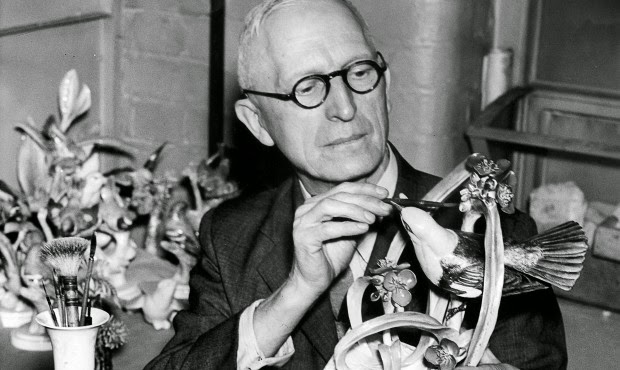
Harry Davis

Harry Davis was born in Worcester in 1885. His father, Alfred, was a china figure maker who worked for Royal Worcester and his grandfather Josiah Davis was one of the most talented gilders ever to work at the factory. Harry started out at St Peter’s School (where the museum is now housed) then at the age of 13, started work for Royal Worcester. Along with all the young boys he began doing very menial tasks and was formally apprenticed for seven years under the talented landscape artist, Ted Salter, on 3 November 1899.
Harry started work under the wing of his grandfather, who taught him to draw. He also learned an enormous amount from his tutor who taught the eager young boy to paint soft misty landscapes in the style of Corot. Harry was deeply shocked when Salter was killed, cycling over a level crossing, on his way to work in November 1902.
Ted Salter had reinforced Harry’s love of the countryside and of fishing. A keen fisherman, Harry was a follower of Isaac Walton, 17th century author of the most successful angling book of all time, ‘The Compleat Angler’. He perfected the difficult art of painting fish with amazing accuracy, possible only to someone with a deep understanding of fish and their behaviour. Harry was an active member of the Royal Worcester Fishing Club and later in life painted two wonderful trophies for the club to present to competition winners each year.
Harry quickly proved that he had tremendous natural ability and striking individuality. He was always versatile and painted a large range of subjects with ease. Landscapes with sheep, cattle, pigs, fish, snow scenes, London Scenes, polar bears, palaces and gardens, but he was never a ‘Jack of all trades’ he would accept nothing less than perfection in everything he did.

On the 4 July 1910 Harry married ‘Cissie’ (Ethel) Powell, a dressmaker, at St Peter’s church that stood next to the Severn Street factory. A fine watercolour of cattle drinking from a stream, given to the couple as a wedding present by their friend Harry Stinton, is now in the museum collection.
Throughout the First World War there was still demand for Harrys work, but in 1916 he volunteered and joined the wireless section of the Royal Engineers. Harry’s abilities were quickly utilised drawing diagrams for instruction purposes, but he also enjoyed painting postcards which he sent to his friends. On the card showing a mountain of equipment at St.Martin’s Gate Parade Ground (just up the road from the porcelain factory) Harry was obviously tickled by the scene before him and commented:
Not quite clear, But very near, Next year?
In 1919 all Royal Worcester employees who served for their country, including Harry Davis, were presented with an urn with their name, department and dates of service inscribed in gold.
In 1923 Royal Worcester received a prestigious £7,000 order from His Highness Shri Ranjitsinhji Vibhaji, Maharaja Jam Saheb of Nawanagar. The legendary Sussex and England cricketer owned palaces in both India and England and wanted a service to use in India illustrating his English estate and a set to use in England decorated with scenes of his Indian home. Harry Davis was given the challenge and designed and painted 24 of the most wonderful scenes. He worked from photographs, yet created views full of light and atmosphere with intricate architectural details that were widely admired.
Harry succeeded William Hawkins as foreman of the ‘Men Painters’ department in 1928. He was responsible for training many young apprentices and in the early 1930s to help with his teaching, Harry produced several sets of etchings for decorative plates, 12 castles, 12 cottages and 12 cathedrals. The scenes were expertly etched onto copper plates and then printed as an outline onto the china. Many artists in the department ‘filled in’ the colours over the printed designs adding their signature to the finished work. Sometimes Harry himself did some of the filling in, signing himself H SIVAD, Davis backwards! Later Harry also etched some wonderful coaching subjects and some of his favourite fish.
Joyce Holloway remembers Harry being so patient teaching the girls to paint:
When orders were scarce during the Depressions, and because if you were under 16 you cocouldn't claim the dole, workers were retained and little jobs were found for them. Harry Davis gave painting lessons to girls to fill in the time… he was very patient and he showed me one or two little ways in drawing …and he was a very nice person [his skills] they seemed to me incredible, they still do.
Over the years Harry completed some very prestigious commissions for special customers. In 1928 he collaborated with his friend Harry Stinton to complete an important order for Mr Kellogg the American Cornflake King. Harry Stinton painted a dinner service of 25 service plates with magical snow scenes, with rich raised gilding on a ruby ground, and Harry Davis painted a matching dessert service of 25 smaller plates and 25 coffee cups and saucers with delicate Corot style landscapes.
In 1937 Davis painted some exquisite panels on the silver-gilt casket presented to Charles William Dyson Perrins when he was given the Freedom of the City of Worcester. The following year Harry painted a stunning vase for the Australian cricketer, Sir Donald Bradman to commemorate his three double centuries on the New Road Ground at Worcester and in his book ‘Farewell to Cricket’ The Don wrote
It showed the field of play, the spectators, the lovely trees along the river bank and dominating the whole scene the architectural masterpiece, Worcester Cathedral. This is one of my most treasured possessions.
In 1950 Harry teamed up with his friend Ivor Williams, the Master Gilder, to produce a jardinière to present to Sir Winston Churchill.
Harry’s talents did not end there. He was also responsible for the design of a number of very successful tableware patterns. The most luxurious ‘Imperial’ with its hand tipped raised gold, was produced for an incredible 76 years, between 1917 and 1993 in five different colours. The popular blackberry garland design, ‘Lavinia’ was made from 1940 to 1986, gold and silver ‘Chantilly’ made from 1958 and 1990 and the ‘Worcester Hop’ pattern, adapted by Harry in 1965 from a Flight & Barr original remained in production for 20 years.
During the years of the Second World War Harry was kept busy painting fine bone china, limited edition models that were made mainly for the American market, to earn precious dollars for the British economy. Harry painted many of the prototypes for Dorothy Doughty’s series of American Bird models and Doris Lindner’s horses. He was always a favourite of the Royal family and in 1949 he was asked to paint a wonderful model of Princess Elizabeth on her horse, Tommy.
Princess Elizabeth personally asked to see Harry again when she visited Royal Worcester for the bicentenary celebrations in 1951 and in the very first honours list of the Queens reign in 1952, he was awarded the British Empire Medal for his contribution to British craftsmanship and design of new lines that helped the company develop its export business.
In 1954 Ben Simmonds took over as foreman of the Royal Worcester painting department, but Harry continued to paint in his studio at the factory for another 15 years. In 1958, to mark 60 years’ service for Royal Worcester, Managing Director, Joseph Gimson, presented Harry and Ethel with a television set and much to Harry’s amazement and embarrassment he appeared on the television himself in 1968. St John Howell told Harry’s story on the BBC Midlands Today programme. He explained how his first job at the factory was to wash the museum steps and he managed to tip up the bucket and soak everything. He was very proud of the first 10 shillings he earned, not a bit of paper, but a half gold sovereign.
What do you think I did with it? Said Harry
Lost it through a hole in my trousers pocket!

Over a period of four years from 1965 to 1969, Harry took on an apprentice Rick Lewis. Harry took Rick under his wing and shared his talents and artistic secrets in his twilight years.  Finally retiring with failing health in 1969, aged 83 Harry Davis always stated that during his whole time at the factory he had been extremely happy. Harry died in 1970. He was always astonished that anyone should want to collect his work, but Harry’s signature guaranteed the very best quality and today Harry’s name on any piece of porcelain guarantees a high price.


Saturday, 15 November 2014

Bone China v Porcelain


Bone china is a type of soft-paste porcelain that is composed of bone ash, feldspathic material, and kaolin. It has been defined as ware with a translucent body containing a minimum of 30% of phosphate derived from animal bone and calculated calcium phosphate. Developed by English potter Josiah Spode, bone china is known for its high levels of whiteness and translucency, and very high mechanical strength and chip resistance. Its high strength allows it to be produced in thinner cross-sections than other types of porcelain.

From its initial development and up to the later part of the twentieth century, bone china was almost exclusively an English product, with production being effectively localised in Stoke-on-Trent. Most major English firms made it, including Mintons, Coalport, Davenport, Royal Crown Derby, Royal Doulton, Hereford Fine China, Wedgwood and Royal Worcester.

The production of bone china is similar to porcelain, except more care is needed because of its lower plasticity and a narrower verification range. The traditional formulation for bone china is about 25% kaolin, 25% Cornish stone and 50% bone ash. The bone ash that is used in bone china is made from cattle bones that have a lower iron content. These bones are crushed before being degelatinised and then calcined at up to 1250°C to produce bone ash. The ash is milled to a fine particle size.  The kaolin component of the body is needed to give the unfired body plasticity which allows articles to be shaped. This mixture is then fired at around 1200°C.  The raw materials for bone china are comparatively expensive, and the production is labor-intensive, which is why bone china maintains a luxury status and high pricing.


Porcelain (also known as china or fine china) is a ceramic material made by heating materials, generally including clay in the form of kaolin, in a kiln to temperatures between 1,200 and 1,400 °C (2,200 and 2,600 °F). The toughness, strength, and translucence of porcelain arises mainly from the formation of glass and the mineral mullite within the fired body at these high temperatures.

Porcelain derives its present name from the old Italian porcellana (cowrie shell) because of its resemblance to the translucent surface of the shell. Porcelain can informally be referred to as "china" or "fine china" in some English-speaking countries, as China was the birthplace of porcelain making. Properties associated with porcelain include low permeability and elasticity; considerable strength, hardness, toughness, whiteness, translucency and resonance; and a high resistance to chemical attack and thermal shock.

  The most common uses of porcelain are for utilitarian wares and artistic objects. It can be difficult to distinguish between stoneware and porcelain because this depends upon how the terms are defined. A useful working definition of porcelain might include a broad range of ceramic wares, including some that could be classified as a stoneware. Porcelain is used to make household wares, decorative items and objects of fine art amongst other things.


Saturday, 8 November 2014

History of Porcelain Painting


History of China Painting

The art of china painting, referenced in many works as porcelain art or china decoration, has its roots in the history of early China.
It is documented that cave dwellers in Turkey as early as 7000 BC began making bowls, jugs, and utensils out of clay. Egyptians built ovens to harden their clay pieces in 5000 BC. However, over glazing was not discovered until around 3000 BC and decoration of the clay ware came much later. It wasn’t until the T’ang Dynasty in 618 AD that the Chinese began making what is known today as hard porcelain. They discovered that combinations of kaolin clay and feldspar resulted in the most beautiful ceramics.
This porcelain ware is distinguished from other ceramics by possessing excellent qualities of hardness, translucency, and whiteness of body or paste. Any ceramic piece that possesses all of these qualities may be classified as porcelain, and, from a practical point of view, the more it excels under these characteristics, the better the specimen of porcelain it is. The Chinese, being supreme secret keepers, remained the masters and sole producers of hard-bodied porcelain until the middle of the 1700s.


Saturday, 1 November 2014

Ceramic Painting - A General Introduction


Ceramic Painting - A General Introduction

The term "Porcelain Painting" or, as it is also called, "China Painting", usually refers to the method of painting on white glazed porcelain objects. The paint used is an onglaze (overglaze) paint. This means it is designed to be used on top of already glazed porcelain or bone china (as opposed to underglazes, which are generally painted on the green ware and fired, after which a glaze is applied).


Technique
 
The general method porcelain painter’s use is to paint a light coat of paint on the porcelain or bone china piece. This may involve one or more colours, after which the piece is fired. Then layers of paint are applied and the piece is fired again. This continues, painting and firing, until the artist feels the painting is complete. The reasons for multiple layers, (called "fires" because of the firing operation between each) is to build up the colour as there a possibility that the paint may blister or "pop" if too much paint is applied at once and different pigments need to be fired at different temperatures.

Porcelain Painting has a smoothness, permanency and translucence. It is not meant to be an opaque paint. It is ideal to portray the smoothness of the human skin, the delicacy of the human eye, and hair and animal fur can be made to appear very realistic. 

There are always risks and errors can easily be made, colours and brush strokes must be as accurate as possible.  One mistake many first-time china painters make is to think that they can correct a wrong stroke in a later fire. China Paint has a semi-transparent appearance. Strokes, even if covered by other strokes after the firing, are still visible. Corrections can usually be made before the layer has been fired, but once the layer has been fired, unless the covering paint is very much darker than the layer below, the earlier painting will show through. This means that, unlike oils or acrylics, you must plan your light areas, colours, details ahead of time.  Visualise the finished piece continuously and work back one step at a time.

Materials

China Paints are a dry powder and are mixed with oils and glycerine. There are other special powders and oils for special paint projects, such as enamelling and raised paste for gold. 

The powdered paints can have a flux in them and if not it can be added. Flux is a fusible substance that causes other substances to melt. Its presence in the paint allows the paint to "melt" into the glazed surface of the porcelain piece during the firing. Since the pigments of China Painting are all mineral, they fuse at different temperatures. The flux is combined in each of the colours in such proportions so that they will melt uniformly when exposed to the fire of the kiln.

Gold, Platinum and lustres, also used in china painting, do not melt into the glaze. They adhere to the top surface of the porcelain. That is why you often see an old plate where the gold rim has rubbed off. It is because it did not fuse into the porcelain. These metallic paints are generally fired at a lower temperature than most regular china paints.

China paints, properly fired will never rub off. They also may be the only thing left should you be unfortunate enough to have a fire consume your home, since the heat of the kiln is usually hotter than that of a home fire.  What a marvellous art investment!

Firing the China Pieces

The complete firing time can take about three or more hours but, because of the intense heat, the kiln should not be opened right after it shuts off. A few hours or overnight (depending on your kiln) are required for the kiln and the piece(s) inside to cool off enough to be removed.

Most China Painting is fired in the temperature range of 600 degrees Celsius to 1000 degrees Celsius

Saturday, 25 October 2014

Bone China v Porcelain

In A Nutshell

Bone china, fine china, porcelain: They can look very similar, but there’s a definite difference in what they’re made from. Bone china is, as its name suggests, made from bone—cow bone in particular, although in rare cases you could be eating off of a plate made from a dead person. The same manufacturing processes are used in making fine china, but without the bone content. Porcelain is also created in much the same way, but it’s fired at a higher temperature and the end result is much harder.

The Whole Bushel


Bone china is, as its name suggests, made from cow bone. The bone is finely ground into bone ash, and it is then mixed with feldspar, ball clay, quartz, and kaolin (a type of clay). The quality of the finished product is based on how much bone is in the mixture; a high-quality bone china should contain at least 30 percent bone and can go as high as 40–45 percent.
Porcelain has been around since around A.D. 620; more modern methods and mixtures started to be used around A.D. 1279. Originating in China, the earliest porcelains used kaolin (a type of clay) and pegmatite (a type of granite). Early European versions used clay and ground glass. In 1707, German manufacturers started using feldspar instead of glass in a process that continues today. In today’s porcelain, silica is also added to the raw ingredients. The raw materials are finely ground, cleaned, formed in a mold, and then fired.

The firing process is what creates either porcelain or fine china. If the temperature is high—around 1,455° Celsius (2,650° F)—the finished product is much more durable and is known as porcelain. If it’s fired at a lower temperature—around 1,200° (2,200° F)—it’s known as fine china. Fine china is much softer than porcelain, making it much more suitable for applications such as plates and cups. Porcelain is strong enough and durable enough that it’s suitable for a wide range of industrial applications such as electrical insulators.

Bone china undergoes two firing processes. The first causes the product to shrink, and about 20% of the pieces that are made will crack and break at this stage. The second firing happens after the piece is glazed, and melts the glaze into the piece. Those that don’t crack or break during this stage are then decorated with their final patterns. Many pieces are hand painted or sprayed, though in some cases decals can also be applied.

At a glance, it’s easy to tell the difference between bone china and fine china if you know what you’re looking for. The addition of bone ash gives bone china a warm color, while fine china will be a brighter white. If you hold the china up to the light, you’ll see that bone china has a translucent quality compared to fine china. Porcelain is a much more durable material, and is much harder than either type of china.

But then there’s the creepier side of china. American artist Charles Krafft has found that it doesn’t have to be cow bone that’s used for the bone component in bone china. The current mixture used for British bone china was created by a man named Josiah Spode (Spode is still a major manufacturer of bone china in the UK), and Krafft decided to simply swap out the cow bone ash in Spode’s recipe for human bone ash, retrieved from a crematorium and finely milled. Calling his new product “SPONE,” you can still commission him to create a special memento made of your loved ones.


source